ISO 45001 Document Control & Training: Why Blended Records Are the Missing Link in Your OHS Management System
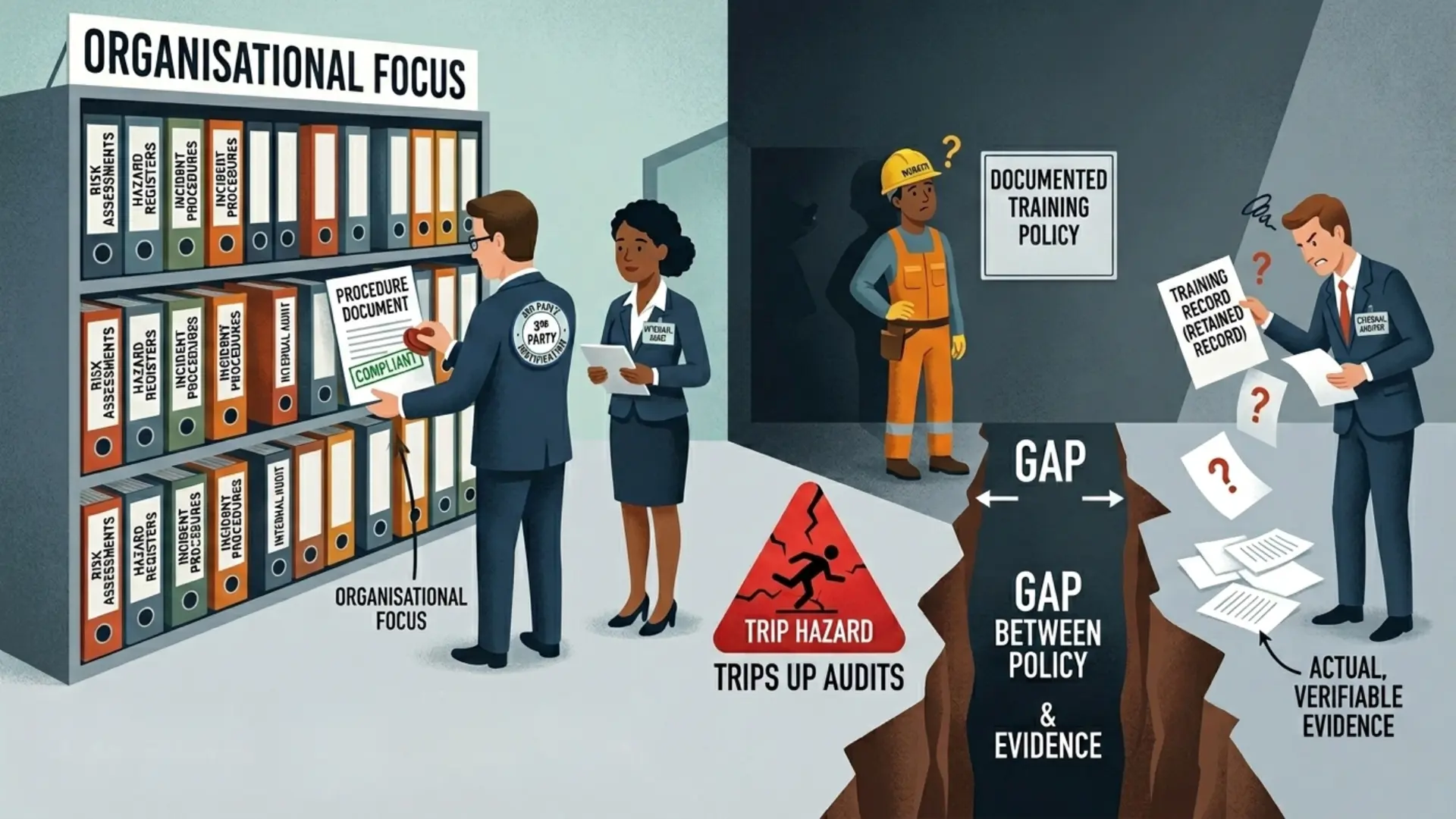
Most organisations working towards ISO 45001 certification focus on the right things: risk assessments, hazard registers, and incident investigation procedures. BHowever, one common blind spot still causes problems in internal audits and third-party certification reviews: the mismatch between written training policies and clear, verifiable evidence that the training actually took place.
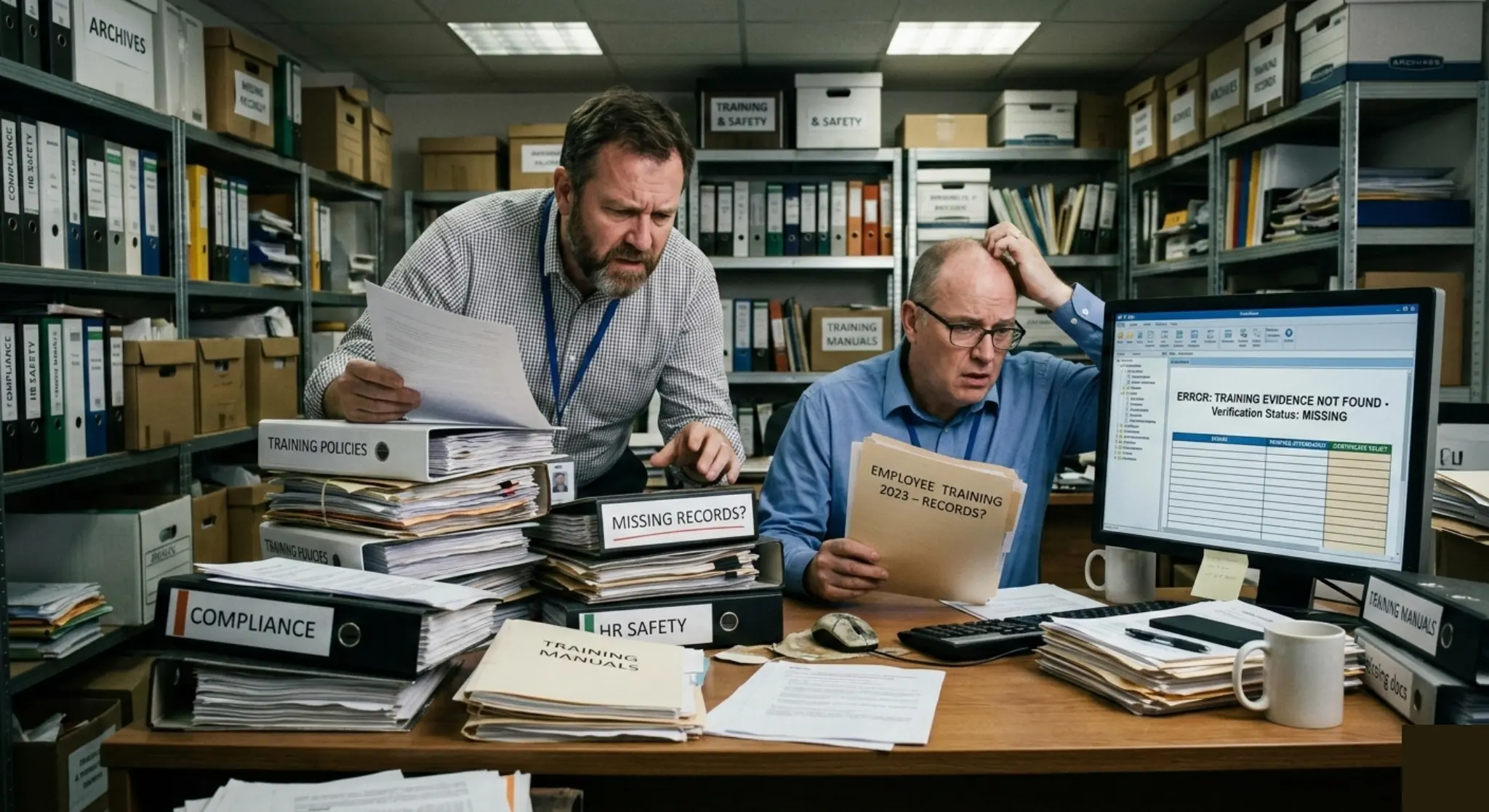
That gap is where blended records come in. And if you are managing occupational health and safety (OHS) across multiple sites, contractors, and employee groups, understanding how blended records function within ISO 45001 Clause 7.5 (Documented Information) and Clause 7.2 (Competence) is not optional – it is the difference between passing and failing your next audit.
This guide breaks down exactly what the standard demands, where organisations consistently fall short, and how purpose-built digital compliance platforms like EduSafe close the gap.
What ISO 45001 Actually Requires: Document Control & Training Evidence
Clause 7.5 – Documented Information
ISO 45001 requires organisations to maintain and retain documented information to support the operation of the OHS management system. This covers two distinct categories:
- Maintained documents (procedures, policies, risk assessments) – these are living documents that require version control, approval workflows, and access management. They must be kept up to date to reflect current practices.
- Retained records (evidence that something happened) – training completion certificates, induction acknowledgements, competency assessments, toolbox talk sign-off sheets. They should never be altered once created.
The standard does not prescribe what format these records must take. Paper files, spreadsheets, and digital systems are all technically compliant – but the auditability requirements mean that informal systems quickly become a liability.
Clause 7.2 – Competence
This clause is where training and document control intersect most critically. ISO 45001 requires organisations to:
- Determine the necessary competence of workers who affect OHS performance
- Ensure those workers are competent based on education, training, or experience
- Take action to acquire necessary competence where gaps exist
- Retain documented information as evidence of competence
Key Audit Requirement: Auditors will not simply ask “do you have a training programme?” – they will ask to see evidence that specific individuals completed specific training, on a specific date, with demonstrated understanding. Generic training logs rarely satisfy this standard.
Defining Blended Records in an ISO 45001 Context
The term “blended records” refers to compliance documentation that combines multiple data streams into a single, coherent evidence trail. In the context of ISO 45001, this typically means:
|
Record Type |
What It Captures |
|
eLearning completions |
Module scores, time-on-task, pass/fail outcomes with timestamps |
|
In-person induction signoffs |
Facilitator confirmation, attendee acknowledgement, date and location |
|
Certification uploads |
Third-party qualifications (forklift, first aid, manual handling) |
|
Toolbox talk records |
On-site briefings with digital or physical sign-off captured in one system |
|
Refresher & renewal tracking |
Automatic alerts when certificates approach expiry |
When these record types exist in separate silos – a spreadsheet for eLearning completions, a paper folder for induction forms, email threads for certificate submissions – the blended picture is invisible. Auditors see fragments. Compliance managers spend days assembling evidence packs. And gaps in coverage go undetected until an incident occurs.
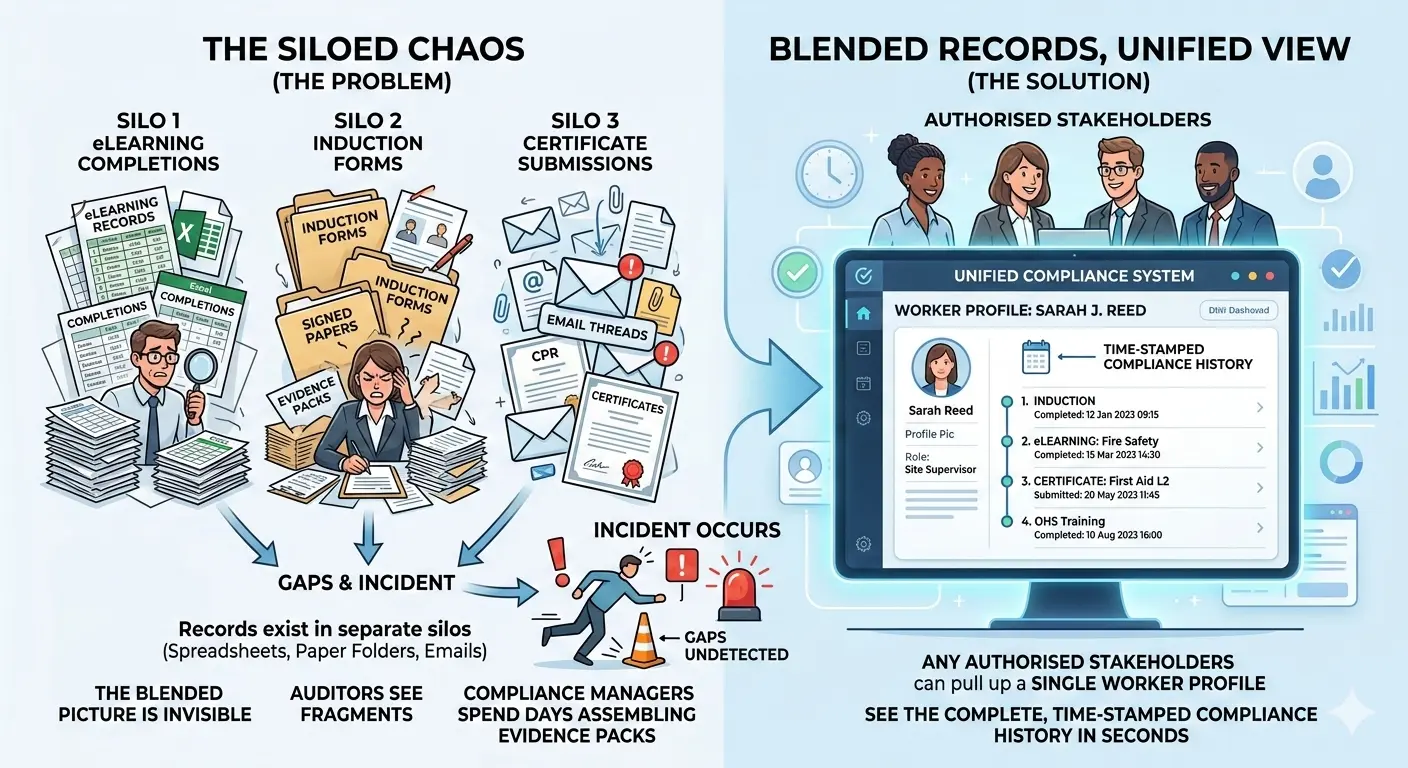
Blended records, properly managed, mean that any authorised stakeholder can pull up a single worker profile and see the complete, time-stamped compliance history in seconds.
The 5 Most Common Document Control Failures in ISO 45001 Systems
Failure 1: No Version Control on Core Safety Documents
Risk assessments and method statements that exist in multiple outdated versions on shared drives are a perennial audit finding. ISO 45001 requires clear identification of the current version, a record of changes, and evidence that workers accessed the current document – not last year’s revision.
Failure 2: Training Records That Cannot Be Linked to Specific Hazard Controls
A generic “Health & Safety Induction Completed” entry does not satisfy Clause 7.2 for high-risk roles. If your manual handling risk assessment identifies a control measure that requires trained personnel, your records must demonstrate that the specific individual operating in that role received training in that specific control.
Failure 3: Contractor Competency Gaps
The scope of ISO 45001 extends to workers under the organisation’s control – which includes contractors. Many organisations maintain strong internal records but have no systematic process for verifying, collecting, and retaining contractor competency evidence before site entry. This is consistently one of the highest-frequency findings in OHS certification audits.
Failure 4: Expired Certifications Not Flagged Proactively
A document control system that records what was completed is only half the requirement. ISO 45001 continuous improvement principles (Clause 10) require that gaps be identified and acted upon. If a worker’s manual handling certificate expired three months ago and no one flagged it, that is a system failure – regardless of whether an incident occurred.
Failure 5: Inaccessible Records During Unannounced Audits
The HSA in Ireland and equivalent bodies in other jurisdictions can conduct unannounced inspections. Organisations that store compliance records across filing cabinets, email inboxes, and disconnected spreadsheets frequently cannot produce the required evidence on demand. The inability to demonstrate compliance is treated the same as non-compliance.
How a Blended Records Approach Satisfies ISO 45001 Audit Requirements
A properly implemented blended records system addresses all five failure modes above. Here is how the components map to specific ISO 45001 requirements:
|
ISO 45001 Clause |
Requirement |
Blended Records Solution |
|
7.5.2 |
Creating & Updating Documented Information |
Version control with approval workflows, audit trail of changes |
|
7.5.3 |
Control of Documented Information |
Centralised repository, access permissions, retrieval within minutes |
|
7.2 |
Competence |
Individual training profiles linking learning outcomes to role-specific hazard controls |
|
7.3 |
Awareness |
Logged induction completions proving workers understand OHS policy and their obligations |
|
8.1.4 |
Procurement / Contractors |
Pre-entry contractor document checks with centralised verification records |
|
9.1.1 |
Monitoring & Measurement |
Real-time compliance dashboards showing training coverage gaps and expiry status |
Practical Example: A manufacturing site with 120 workers and 40 active contractors needs to demonstrate Clause 7.2 compliance at audit. With a blended records platform, the compliance manager generates a single report in under 60 seconds showing: who is fully compliant, who has gaps, which certifications expire in the next 30 days, and which contractors were cleared for entry last quarter. Without it, that report might take two days to compile – and still contain errors.
Building a Blended Records Framework: Step-by-Step
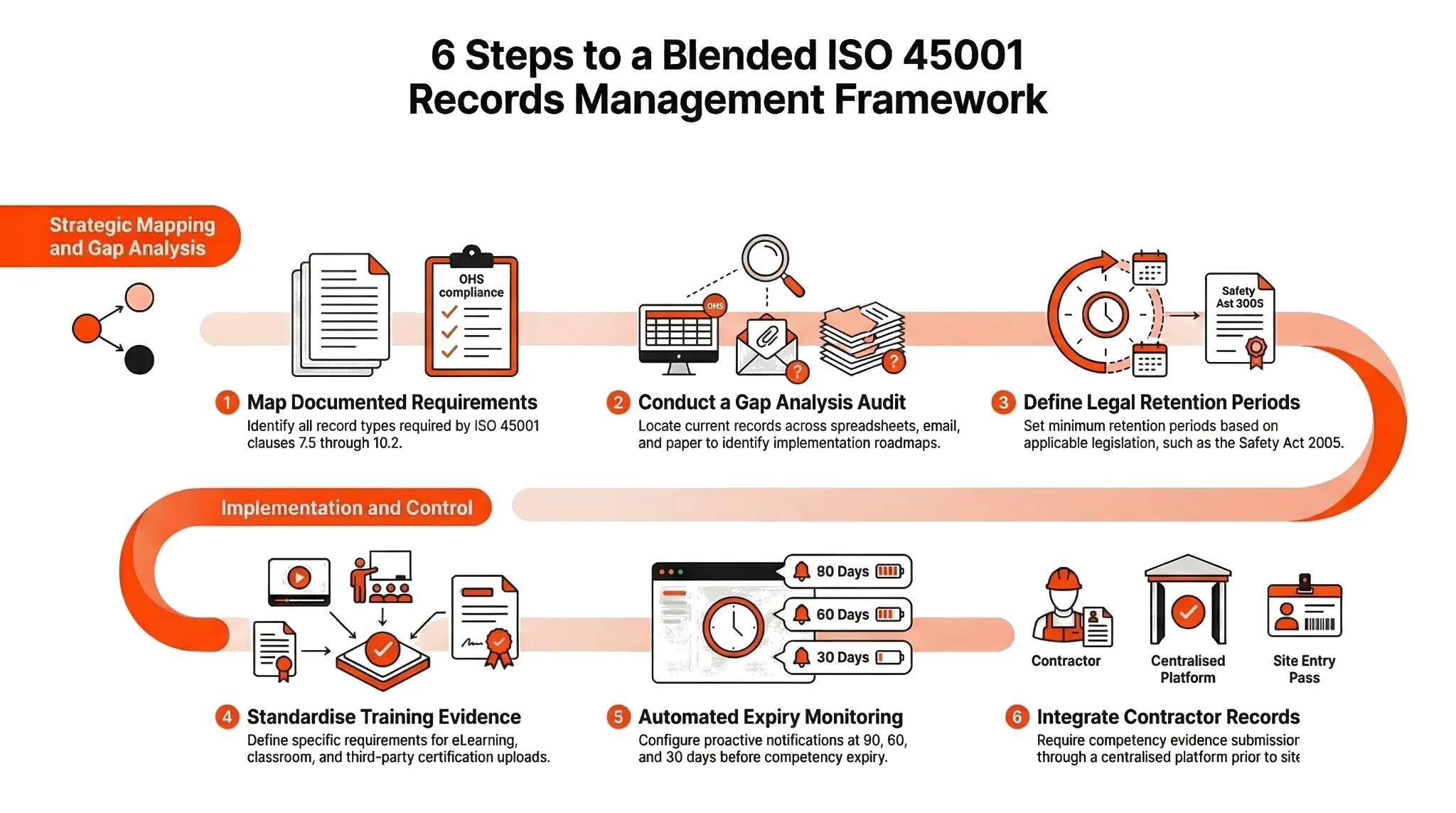
Step 1 – Map Your Documented Information Requirements
Before digitising anything, map what ISO 45001 requires you to maintain and retain. Start with the clauses that directly reference documented information (7.5, 7.2, 8.1, 9.1, 9.2, 9.3, 10.2) and identify every document or record type your system must produce.
Step 2 – Audit Your Current State
Identify where each required record currently lives. The typical finding is: some records in a spreadsheet, some in a shared drive, some in email, some on paper, and some not captured at all. This gap analysis becomes your implementation roadmap.
Step 3 – Define Your Record Types and Retention Periods
ISO 45001 does not specify retention periods – but applicable legislation (such as the Safety, Health and Welfare at Work Act 2005 in Ireland) does. Define minimum retention periods for each record type and ensure your system enforces them.
Step 4 – Standardise Training Evidence Capture
For each training type (eLearning, classroom, on-the-job, third-party certified), define what constitutes sufficient evidence of completion:
- eLearning type: score + timestamp + pass confirmation.
- Classroom type: facilitator sign-off + attendee acknowledgement.
- Third-party type: certificate upload with expiry date.
Step 5 – Implement Automated Expiry Monitoring
A blended records system without automated alerts is still a reactive system. ISO 45001 Clause 6.1 requires proactive identification of risks, and an expiring competency certificate is a foreseeable risk. Configure automated notifications at 90, 60, and 30 days before expiry as standard practice.
Step 6 – Integrate Contractor Records
Extend the same document control rigour to contractor records. Require contractor companies to submit competency evidence through your platform before workers are cleared for site entry. Maintain a centralised log of what was submitted, when, and by whom.
EduSafe and ISO 45001: Purpose-Built for Blended Records
EduSafe is an all-in-one compliance management platform designed for organisations operating under HSA requirements and international standards, including ISO 45001. Its architecture is built around exactly the blended records challenge described in this article.
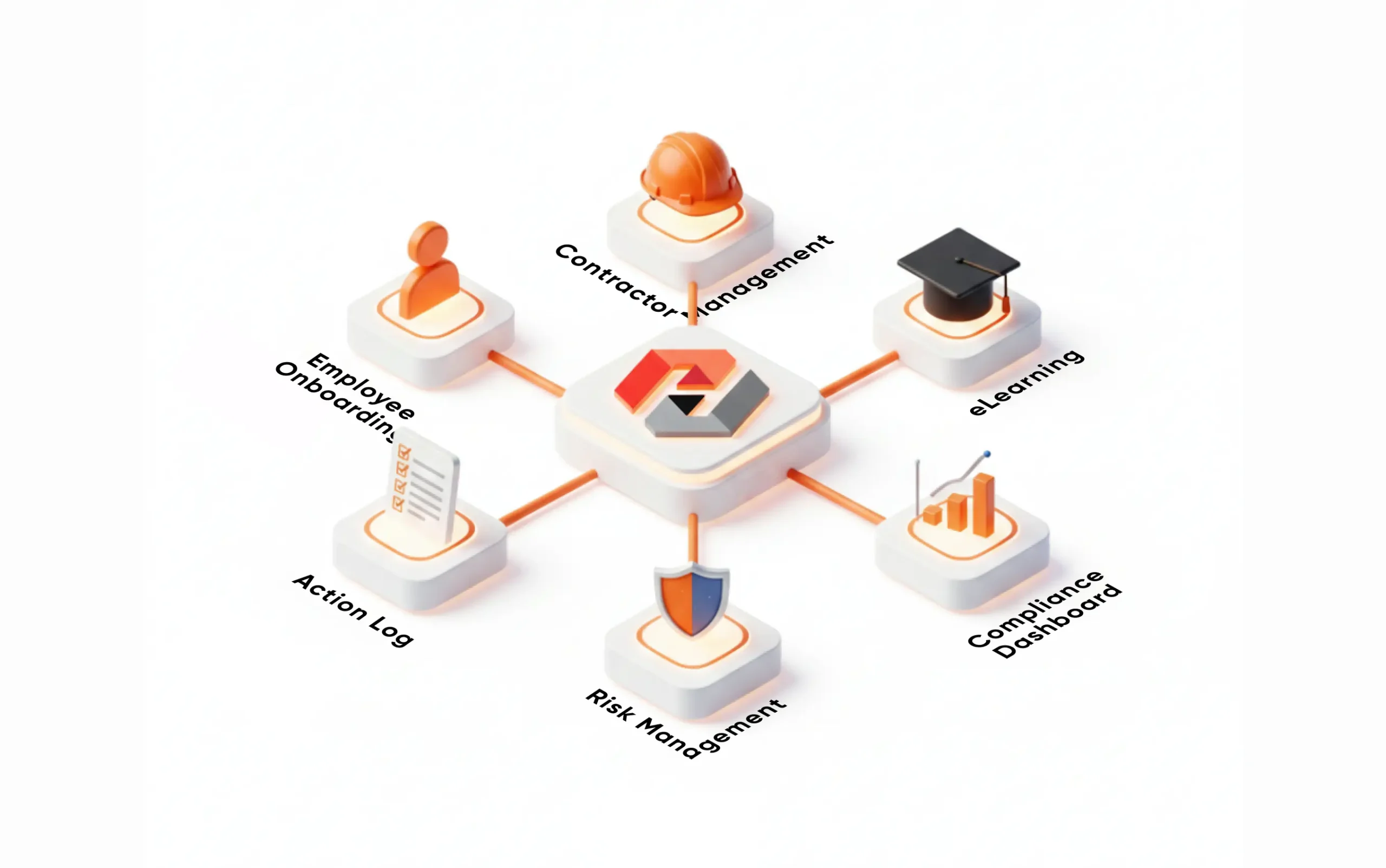
Digitises inductions end-to-end: employees complete eLearning modules, acknowledge policy documents, and submit certifications – all in one workflow. Every step generates a timestamped record that is automatically linked to the worker’s compliance profile.
Manages contractor documentation across multiple sites. Contractors submit their competency evidence through a structured, multilingual workflow. Compliance managers can approve, reject, or flag missing documents before any contractor enters the site. All records are centralised and audit-ready.
Transforms complex OHS regulations into interactive, multilingual courses. Completion data – including scores, time-on-task, and pass/fail outcomes – flows automatically into the worker’s compliance record. Supports SCORM/xAPI for integration with existing LMS infrastructure.
Identifies hazards, scores risks, and tracks mitigation controls with digital workflows aligned to HSA expectations. Every risk assessment is version-controlled and linked to the relevant competency requirements – creating a direct, auditable connection between your hazard register and your training records. This is the exact evidence chain Clause 6.1 and Clause 7.2 auditors look for.
Live dashboards provide real-time visibility of training coverage, certification status, and compliance gaps across every site and team. Generates audit-ready reports in seconds. Configurable alerts surface expiring certifications before they become compliance failures.
Tracks corrective and preventive actions from identification to closure – directly satisfying ISO 45001 Clause 10.2 requirements for nonconformity and corrective action documentation.
ISO 27001 Certified: EduSafe is GDPR and ISO 27001 certified, with encrypted storage and full audit logs. Sensitive employee and contractor data is protected at rest and in transit. This meets ISO 45001 requirements for secure documented information under Clause 7.5.3.
Conclusion: The Competitive Advantage of Audit-Ready Records
ISO 45001 is not a box-ticking exercise. It is a clear framework for reducing workplace injury, illness, and death. The document control and training evidence requirements exist for a reason. Without them, organisations struggle to spot gaps. They may not learn from incidents. They also cannot show continuous improvement.
The organisations that achieve and maintain certification most efficiently treat their compliance management platform as infrastructure. They do not treat it as administration. When your records are complete, centralised, and automatically maintained, audits confirm what you already know. They are not a stressful search for evidence.
Ready to Close the Compliance Gap?
EduSafe is purpose-built to help organisations across manufacturing, construction, pharmaceutical, and government sectors achieve and maintain ISO 45001 compliance. From digital onboarding to real-time dashboards, every module is designed around audit-ready blended records.
Start your free 30-day trial at edusafe.ie – no credit card required.
Frequently Asked Questions
1. What are blended records in ISO 45001?
A single worker profile brings together eLearning completions, induction sign-offs, and third-party certifications. It creates one audit-ready evidence trail. This helps meet Clauses 7.2 and 7.5.
2. What does ISO 45001 Clause 7.5 require?
Version-controlled documents with a named approver and proof workers accessed the current version before undertaking high-risk work.
3. How does Clause 7.2 relate to training records?
It requires competency evidence linked to specific hazard controls – not just a generic training log. Auditors will check the connection between training and your risk assessments.
4. What is the difference between maintained documents and retained records?
Maintained documents provide instructions or define processes. They must be kept up to date to reflect current practices. Retained records provide evidence that an activity took place. They should never be altered once created. Both are required under Clause 7.5.
5. Can a digital platform satisfy ISO 45001 document control requirements?
Yes. ISO 45001 does not mandate a specific format. Digital platforms like EduSafe reduce version control failures and make records instantly retrievable during unannounced HSA inspections.
6. How does EduSafe support ISO 45001 document control?
EduSafe brings all compliance records into one platform. It includes real-time dashboards, automated expiry alerts, and audit-ready reports. These features map directly to Clauses 7.2, 7.5, 8.1.4, and 9.1.1.
About the author:
EduSafe Team comprises compliance specialists, safety practitioners, and digital transformation experts focused on modernising how organisations manage health, safety, and regulatory compliance.
Drawing on over 20 years of experience working with organisations across manufacturing, construction, pharmaceutical, and government sectors, the team provides insights on improving compliance workflows, reducing administrative burden, and maintaining audit-ready documentation aligned with Health and Safety Authority (HSA) standards and industry regulations.